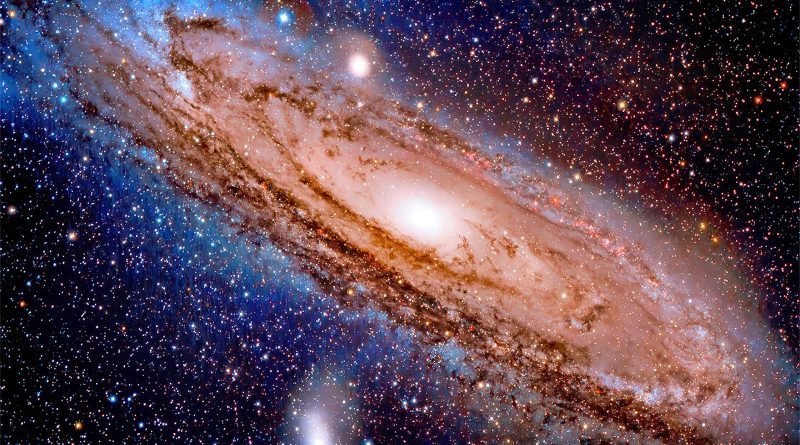
We have the most complex three-dimensional image of our galaxy
Did you know that there is a Dark Energy Spectroscopic Instrument (DESI)? Me neither! It is currently facing the sky from its home at the Kitt Peak National Observatory in Arizona and is tasked with charting the expansion of space, investigating dark energy, and creating the most detailed 3D Map of the Universe ever created. ever. This is to understand what it is used for.
The program is relatively new, as only seven months have passed since the beginning of the mission. However, we already have a record-breaking, stunning three-dimensional image of the galaxy around us, which demonstrates the capabilities of DESI and its potential for space mapping.
The Dark Energy Spectroscopic Instrument has already cataloged and mapped over 7.5 million galaxies, with over one million galaxies added each month. By the end of the full scan, in 2026, more than 35 million galaxies are expected to be processed, giving astronomers a huge library of data.
DESI is made up of 5,000 fiber optics, each individually controlled and positioned by its own tiny robot. These fibers must be positioned accurately to 10 microns, or less than the thickness of a human hair, and then capture light as it seeps into the Earth from the cosmos.
Through this network of fibers, the instrument imagines the color spectrum of millions of galaxies, covering more than a third of the entire sky, before calculating how much light has been shifted to red – that is, how much has been pushed toward the red end of the spectrum due to the expansion of the Universe.
Because it can take up to billions of years for this light to reach Earth, it is possible to use redshift data to see the depth of the Universe: the farther the redshift, the farther away it is. In addition, the structures mapped by DESI can be reversed to see the initial formation in which they started.
The main goal of DESI is to reveal more about the dark energy that is believed to represent 70% of the Universe, as well as to accelerate its expansion. This dark energy could lead galaxies into infinite expansion, cause them to collapse on themselves or something in between – and cosmologists are eager to narrow down their options.
The 3D map that has already been released shows that scientists do not have to wait for DESI to finish its work in order to start benefiting from its deep gaze in space. Other improved DESI research is exploring whether or not smaller galaxies have their own black holes, as larger galaxies do.
The best way to identify a black hole is to identify the gas, dust, and other materials that are dragged into it, but this is not easy to see in smaller galaxies – something that should help you with high-precision spectral data. collected by DESI.
Then there is the study of quasars, especially light galaxies powered by supermassive black holes, which act as indicators over billions of years of space history. DESI will be used to test a hypothesis around quasars: that they start surrounded by an envelope of dust that is expelled as time passes.
In fact, it is believed that the amount of dust around a quasar affects the color of the light it emits, which makes it a perfect job for DESI. The instrument should be able to collect information on about 2.4 million quasars by the end of its study.


