
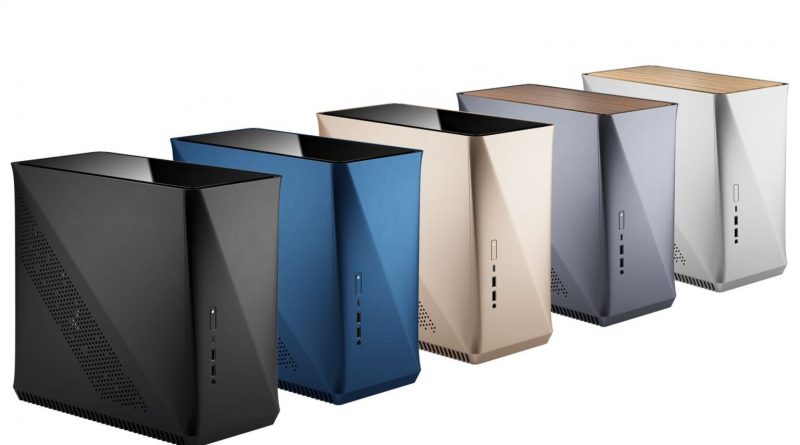
Fractal Design was ITX – Case presentation
In order to attract the sympathy of as many categories of users as possible, in the last few years the Swedes from Fractal Design have constantly refreshed their product portfolio.
The only ignored category was the mini-ITX enclosures, which has not received any new members since the launch of Nano S in 2016. The ultra-compact enclosures have exploded in popularity lately, so the Swedish manufacturer came with a response to this market segment a few weeks ago.
The new housing from Fractal Design is called ITX Era and aims to eliminate most of the restrictions we encounter when making a mini-ITX system.
It is made in collaboration with Intel and has an aluminum construction, complemented by elements of wood or glass for added elegance. It has a volume of only 16 liters and, among other things, boasts of dual slot graphics support, all-in-one cooling solutions with radiators up to 240 mm and up to four storage units.
In addition to SFX and SFX-L sources, which are mandatory in most mini-ITX enclosures, the ITX Era also supports ATX sources, thus facilitating users’ easy transition to a compact system.
For airflow the housing goes on a chimney type design, the intake is low and the hot air is removed on the top.
It is available in five SKUs, three with secure top glass panel (Cobalt, Carbon and Gold) and two with wood finish panel (Silver – White Oak and Titanium Gray – Walnut), all at the same recommended price – 164.99 Euro .
The packaging is solid and has adequate protection inside, and the accessories arrive in a dedicated box and are very well organized.
In addition to screws, spacers and plastic collars we also receive two panels for the upper side: one perforated metal, optimized for airflow and one without perforations, with wood finish or secure glass, depending on the color chosen.
Also included is an installation manual in English, well written and with suggestive illustrations.
It’s hard to figure out from the photo, but the Era ITX is an extremely compact case even for the ITX standard, with a volume of only 16 liters. It measures only 325 mm long, 166 wide and 310 mm high and weighs around 4 kg.
The design deviates from the specific Fractal Design and goes on bolder, irregular shapes, while maintaining an elegant appearance of solid product and great attention to detail.
Unfortunately, or fortunately for some, we do not have a secure glass side panel or RGB lighting elements, the sober appearance and functionality still remaining the main priorities of the Swedish manufacturer.
As soon as we go to the back we notice a few details that give the ultra-compact dimensions of the housing. There are two expansion slots, and the fan pre-installed in the rear is a small one, only 80 mm.
Another interesting detail that emerges is the positioning of the expansion slots just like the ATX enclosures, so the video card does not need a riser and is inserted directly into the motherboard.
For the upper side we choose, as I said above, with two panels. One without perforations, with wood finish for the Silver – White Oak and Titanium – Gray Walnut color variants, and a perforated metal one.
The first has the advantage of a more pleasant appearance and a lower noise level, while the other provides better ventilation and, consequently, lower temperatures.
Both benefit from the attachment with magnets at six points, maintain a firm contact and detach extremely easily. For the Cobalt, Carbon and Gold color versions, the non-perforated panel comes with an opaque secure glass finish.
Fractal Design Era ITX is one of the attractive ITX enclosures on the market, offering an extremely compact construction with a volume of only 16 liters and extended compatibility with a wide variety of hardware components.
Despite the fact that it does not have a safety glass side panel or RGB lighting elements, the case is also noticeable by its solid and attractive design, suitable for both office and living room use. It is also appreciated that we have support for ATX sources, but also for 240 mm all-in-one cooling systems and many storage units, the interior space being optimized to the maximum.
Basically, if you already have a video card as compact as you can migrate to a build in ITX only by changing the motherboard and, if necessary, the cooling solution for the processor.
My main dissatisfaction is airflow. There are many missed opportunities in this chapter, but most of all I miss the lack of perforations at the base.
A top video card, especially one with an open air design, will most likely be “suffocated”, and this will lead to high temperatures, thermal throttling and an annoyingly high noise level. If we are still offered the alternative of a mesh panel for the top, wouldn’t it be logical that the base of the housing, where the intake is made, would benefit from the same treatment? As I said before, this is the main reason why I think that Fractal Design Era ITX is not really the best choice for a high performance gaming system.
It works great for an HTPC or casual gaming system, but for high-end hardware we have many alternatives that, while not coming in an equally appealing design, emphasize ventilation. A solution to improve ventilation on the ITX Era would be drilling the base panel with a 15-20 mm drill and using higher legs. And I think that’s what I’m going to do for a future build.
The reason why we did not present you a complete build and concrete results for the temperatures is because we did not have a dual slot video card within the allowed limits, but I hope to come back with details and a complete build as soon as possible. .
The case has a recommended price of 164.99 Euro for all color variants. It is not yet listed in the profile stores in Romania, and in retailers in the European Union it is no longer in stock, most likely due to the global crisis we are currently facing. I have no information on its availability in the next period, but I will update the article as soon as I receive news from the manufacturer.


